MIJ GOTHENBURG
Swiss Refineries Launder Dirty Gold From the Amazon
.
.
.
.
.
.
.
.
.
.
.
.
Photo: SOURCE OF PHOTO HERE
BY NICOLAS BERLINGER, SANDRA DANIEL, SARA ISTEFAN & KELSEY LESCOP
JANUARY 4, 2023 | 16:00 CET
PRESS PLAY TO LISTEN TO THIS ARTICLE
There is one myth that has captivated the imaginations of adventurers and miners since the arrival of Europeans on the American continent: the search for “El Dorado”, a mythical golden city hidden somewhere deep in the hinterlands of the Amazonas jungle.
For some, El Dorado was once a real place: a city of gold and dreams clinging to the edge of the jungle. This city, La Pampa, an illegal mining town in the Madre de Dios region of Peru, was founded 500 years after the arrival of the conquistadores, but there were no shining gold roofs nor much glamor. The city was a hotbed for local organized crime and illegal miners and traders. It played host to human trafficking, forced prostitution, and child labor and was ground zero for a slow-burning environmental disaster.
By Nicolas Berlinger
But the dream of La Pampa could not last. In 2019, President Martin Vizcarra launched “Operacion Mercurio”, a joint operation between the police, the military and government law enforcment in their “war against the illegal mining industry” of Madre de Dios. The operation saw more than 1,200 police members, 300 soldiers and 70 sepcialized attorneys flood the region, dismantlying the city of La Pampa, liberating more than 4,000 people from human trafficking networks, and installing three military bases in the region.
After some initial success, new repots suggest that, rather than providing a solution, the operation has simply displaced the problem into other parts of the region. “Mercurio” was unable to untangle the root casue of Peru’s struggles with illegal mining: a failure to integrate small scale miners into the legitimate mining industry.
Small scale mining operations are referred to as “artisanal” in industry jargon. These operations are often low-tech and run by individuals in precarious financial circumstances. They are usually not officially registered with the government and will most often mine on public land that is not leased out for legal exploitation. Artisanal miners are estimated to account for 20 percent of Peruvian gold production, but they represent over 90 percent of the industry’s labor force.
In June 2022, Peruvian president, Pedro Castillo met with an industry group representing artisanal and small-scale miners in an effort to both improve coordination with the Peruvian Ministry of Energy and Mines and reform national legislation in favor of an improved formalization process for artisanal miners.
This hopeful moment for the industry did not last long. In the six months since that meeting, Castillo has been ousted from his position as president and was recently imprisoned on corruption charges in a complex political scandal that involves attempted constitutional changes and a long-simmering battle between the Peruvian legislature and the executive under Castillo. As Mr. Castillo’s future seems increasingly uncertain, the Madre de Dios region has found itself in the center of the political storm as protests erupt in support of the former president.
Attempts to formalize artisanal mining must also contend with the tremendous pressure that illegal traders and supposedly-legal end users like western gold refineries put on small scale miners by routinely circumventing the law and offering markets for the sale and distribution of illegal gold.
The illegal trade starts in small offices in places like La Palma. Many of these buyers operate in networks often compared to North American and European mafias, with extended families operating collectively to source and market illegal gold, trap artisanal miners in contracts that force them to produce under unfair conditions, and which frequently resort to violence against miners, activists and each other in order to enforce and protect their businesses.
Once in the hands of traders, illegal gold is pooled and mixed in with batches of legal gold. Sales receipts are forged or edited in order to create a legal provenance for the product. The end goal being to get the gold into the hands of refiners, as once the ore is processed at a refinery it becomes essentially untraceable and impossible to prove that it had been illegally mined.
“One small mountainous country almost halfway across the world buys almost all of Peru’s gold.”
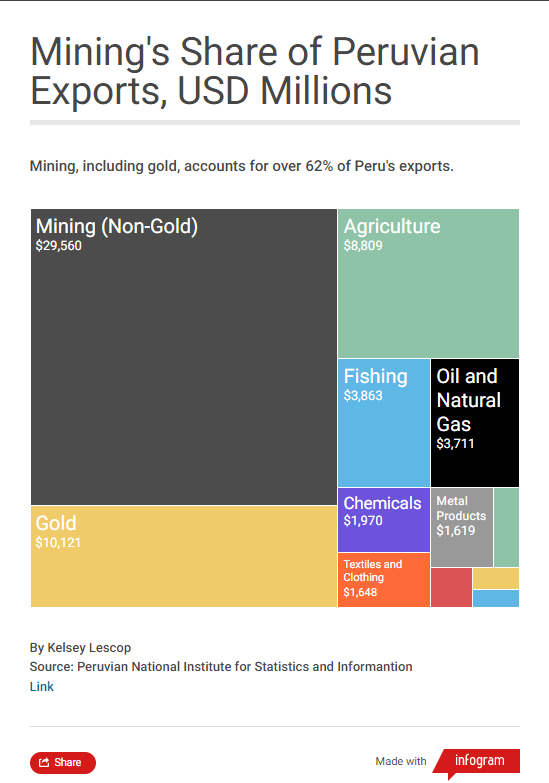
Gold is an important part of the Peruvian mining industry, which is in turn a significant part of the national economy. Mining and hydrocarbon extraction alone accounted for about 11.6% of the Peruvian economy in 2021, and the industry accounts for over 62% of the country’s exports. Gold alone accounts for a quarter of the value of Peru’s mining industry, and the country is the eighth largest producer of mined gold in the world.
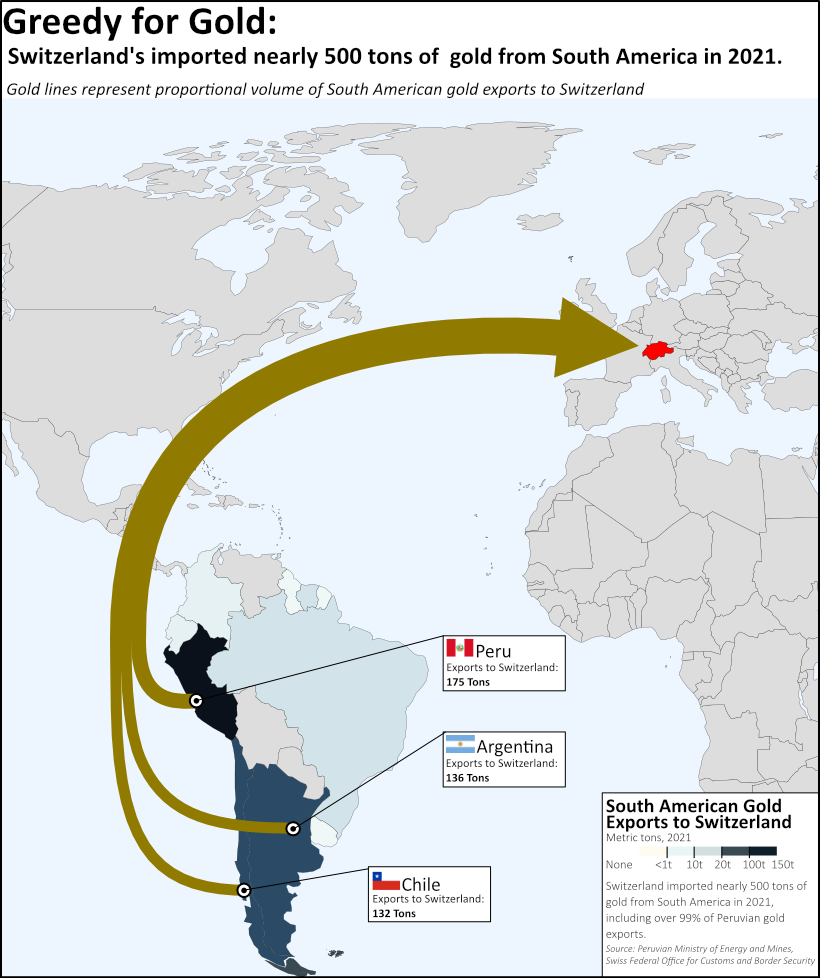
One small mountainous country almost halfway across the world buys almost all of Peru’s gold. Peruvian government data reports that in 2021, the country exported 175 tons of gold. In that same year, Swiss government customs data reports imports of Peruvian gold amounting to 174 tons.
The Swiss Connection
Switzerland is perhaps not the first country that people think of when the topic of refineries comes up. But the country has found a niche for itself in the refining of precious metals, including gold. It plays host to five enormous refineries, which between them are capable of refining nearly 100% of the world’s mined gold. The refineries also work with old jewelry, ingots, coinage, and other precious metals which make up a significant portion of their business. Estimates from industry groups and international organizations indicate that in any given year, about two thirds of the world’s gold will pass through Switzerland.
The close trading relationship between the two countries is reflected in a long, shared history of scandals and governmental prosecutions concerning the gold trade. Much of that history focuses on the Swiss metals refiner Metalor.
Metalor is perennially embroiled in controversy related to its Peruvian gold purchases: In 2011, the company was connected to the revelation that a senior director at Peru’s Ministry of Energy and Mines, Luis Zavaleta Vargas, was also the owner of one of the country’s largest gold exporters, Universal Metal Trading, SAC. Further investigations revealed that another company owned by Mr. Vargas’ brother had sold gold sourced from the Madre de Dios region directly to several Swiss refiners, including Metalor.
In 2018 it was revealed that Metalor’s main supplier of Peruvian gold, Minesur, had exported more gold to Switzerland than the output of the entire region where the company was allowed to operate, strongly suggesting that at least part of the company’s gold had been sourced illegally. Later that same year, 91 kilos of gold destined for a Metalor refinery was seized on suspicions that the gold originated from illegal mines in the Madre de Dios region.
On the heels of the 2018 revelations, Metalor exited the Peruvian gold market entirely while at the same time discontinuing its trading relationships with all small and medium sized gold producers in South America.
Metalor’s official exit from Peru does not necessarily entail a forgoing of illegal Peruvian gold. Peruvian officials have noted that since 2011, there has been a dramatic increase in transshipments of gold out of landlocked Bolivia through Peru. Since the Madre de Dios region shares a porous border with Bolivia, many illegal miners and traders simply smuggle the gold to Bolivia, where it essentially laundered into “Bolivian” gold, and where companies like Metalor continue to operate.
Metalor is just one of many large gold refineries in Switzerland, all of which have similar histories of scandal and corruption across the gold-producing world. Indeed, the Swiss gold refining industry is frequently the target of critical reports from humans rights groups and think tanks such as The Society for Threatened People, a Swiss NGO that accuses the industry of being “repeatedly and at various levels in conflict with human rights, environmental protection and transparency, and only insufficiently disposes of suitable verification systems.”
Efforts to reform the country’s relationship with the gold market have fallen flat. The Responsible Business Initiative, a referendum in 2020 aimed at penalizing Swiss companies complicit in human rights violations abroad, was narrowly rejected despite receiving a majority of votes. Swiss law mandates that referendums must receive both a national popular majority and a majority in 12 of the country’s cantons in order for the initiative to pass. The campaign was marked by controversial political tactics rarely seen in Switzerland, including defamatory videos targeting the supporters of the campaign.
Back in the Amazon, the illegal mining trade continues on. In some ways the Peruvian government seems to acknowledge its inability to cope with the problem: data provided by the Ministry of Energy and Mines reported 174 tons of gold exported last year, but reports 97 tons of gold production. The gap between those two numbers represents the illegal gold trade.
For Switzerland, a country that prides itself on its ancient democratic traditions and astute adherence to the rule of law, its almost total embrace of Peruvian gold at the very least suggests tacit complicity and possibly indicates a broader collusion with the illegal market. While the Swiss profit from extensive gold laundering activities, they are at the same time unraveling the social fabric of Peru.